Cron Expression Parser
Enter a standard five-field cron expression and read what it means, field by field and as a single sentence.
How it works and known limits
The five fields
Cron expressions contain minute, hour, day of month, month and day of week. An asterisk means every value, a number means that exact value, a range such as 1-5 includes both ends, a step such as */5 means every fifth unit, and commas combine several values.
How the description is built
The parser expands each field into the set of values it matches and then turns those sets into readable phrases. It also detects the common schedules such as every minute, every hour at a fixed minute, or a fixed weekday time, and produces a single summary sentence.
Known limits
This tool covers standard five-field expressions and not the six or seven field Quartz and Spring variants that include seconds or a year. When both day of month and day of week are restricted, many cron implementations use an OR rule; the explanation notes this rather than trying to emulate a specific scheduler.
How to read a cron expression (with screenshots)
Translate a five-field cron schedule into plain English, field by field.
Open the Cron Parser
Open the Cron Parser page. The cron expression is where your work begins; the result appears on the right.
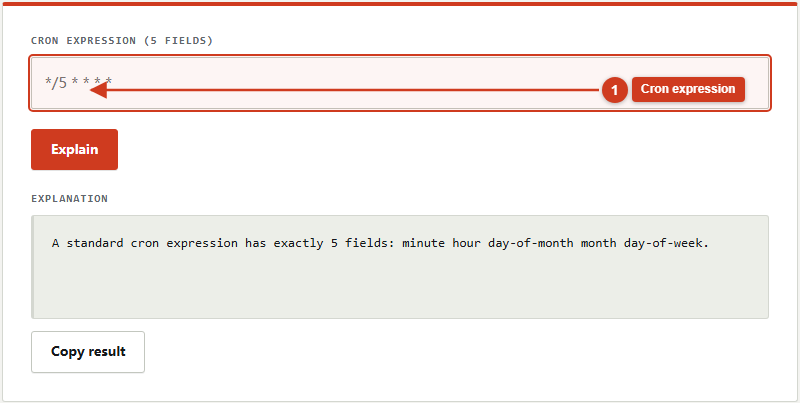
Enter your input
Enter a standard five-field cron expression. This one means 09:00 on weekdays.
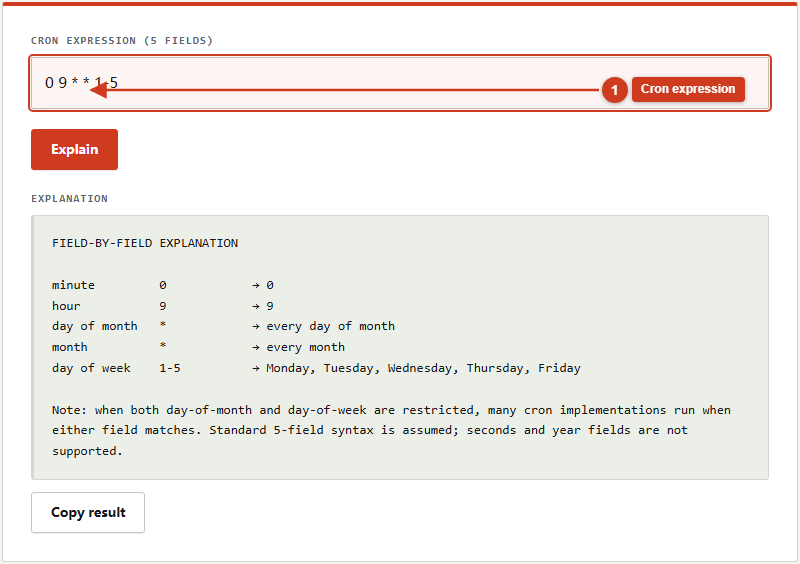
Run the tool
Click Parse expression to expand each field. Each line explains one field with the values it expands to and the equivalent names for months and weekdays.
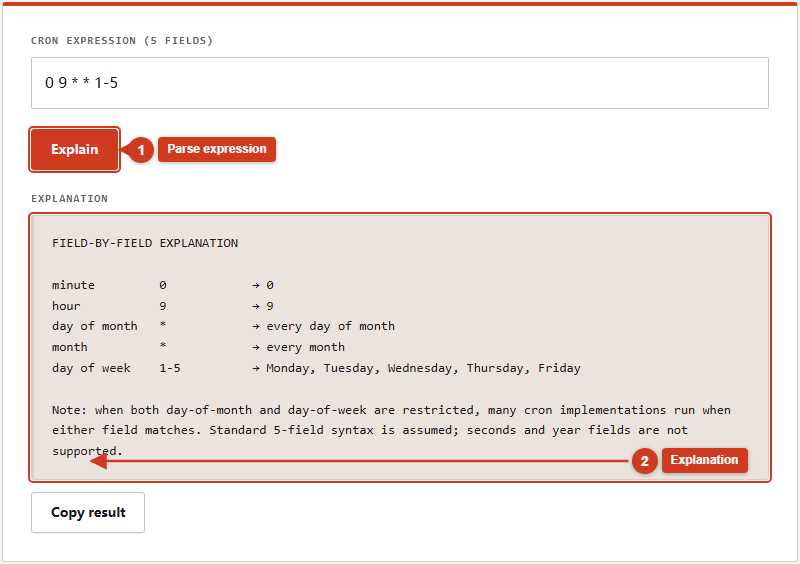
Tip: Standard five-field syntax is assumed; seconds and year fields are not supported.
Frequently asked questions
Which cron format is supported?
Standard five-field expressions: minute, hour, day of month, month and day of week.
Does it support seconds fields?
No. Six and seven field variants used by Quartz are outside the scope of this parser.
What does */5 mean?
Every fifth unit. In the minute field that means at minutes 0, 5, 10 and so on.
Is my expression uploaded?
No. Parsing and explanation happen locally in your browser.
Page last reviewed: