Password Strength Checker
Type a password to see a strength rating, an entropy estimate and a rough idea of how long it would resist an offline attack.
How it works and known limits
How strength is estimated
The tool looks at length and which character classes are present: lowercase, uppercase, digits and symbols. It estimates the size of the character pool and computes entropy as length times the base-two logarithm of that pool size. Entropy is the standard way to talk about password strength and doubles in difficulty with every extra bit.
Crack time is a rough model
The time estimate assumes an offline attacker trying a large number of guesses per second against a fast hash. Real crack time depends on the hashing algorithm, hardware and whether the password appears in a breach list. Treat the number as an order-of-magnitude guide, not a promise.
Limits and safety
A long passphrase of common words can score highly here yet still be vulnerable to a dictionary attack, because the estimate assumes random characters. Never reuse passwords, and store results in a password manager. This tool does not send your password anywhere, but avoid testing a live production password on a shared computer.
How to check password strength (with screenshots)
Estimate a password's entropy and offline crack time from its length and character variety.
Open the Password Strength Checker
Open the Password Strength Checker page. The password is where your work begins; the result appears on the right.
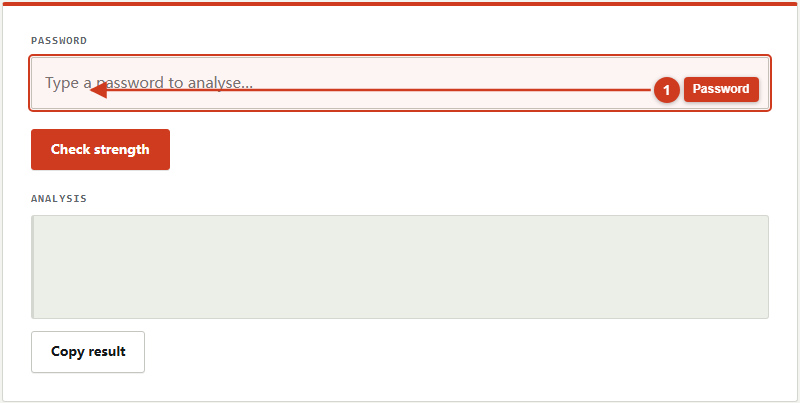
Enter your input
Type a password to analyse. Mixing cases, digits and symbols scores highest.
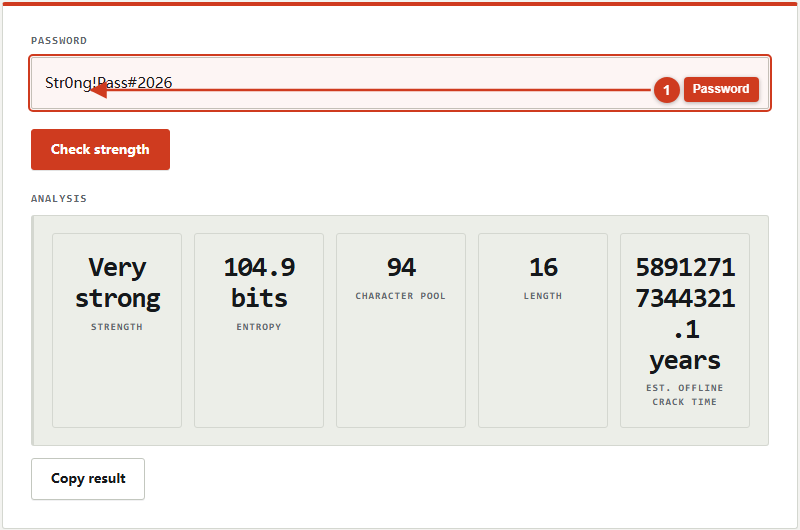
Read the result
The result shows a strength label, entropy in bits, the character pool, length and an estimated crack time.
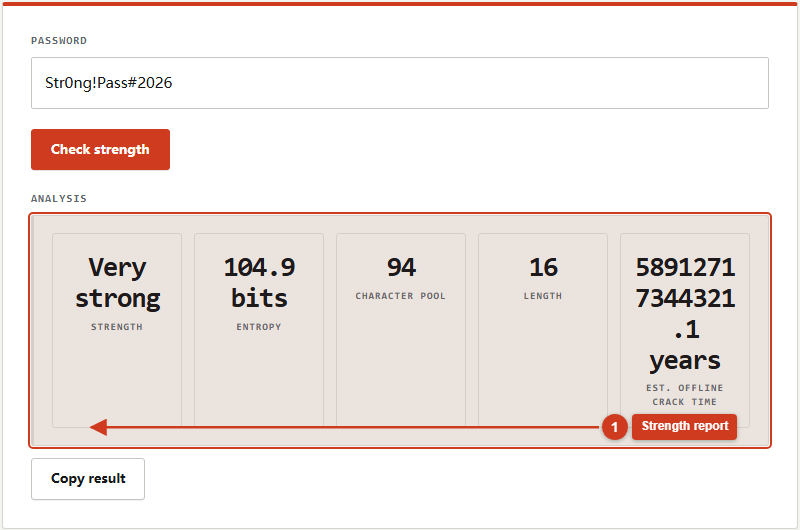
Tip: Length matters most: a long passphrase of random words usually beats a short password full of symbols.
Frequently asked questions
Does this store or send my password?
No. Analysis runs entirely in your browser and the password is never transmitted or saved.
What does entropy in bits mean?
It measures unpredictability. Roughly, every additional bit doubles the work an attacker needs.
Why is my long passphrase rated lower than expected?
The estimate assumes random characters. Real words are more predictable than random symbols, so a dictionary attack can be faster.
What makes a strong password?
Length is the biggest factor. Aim for at least 16 random characters, or a long passphrase, and use a unique password for every account.
Page last reviewed: